Turas Cholm Cille
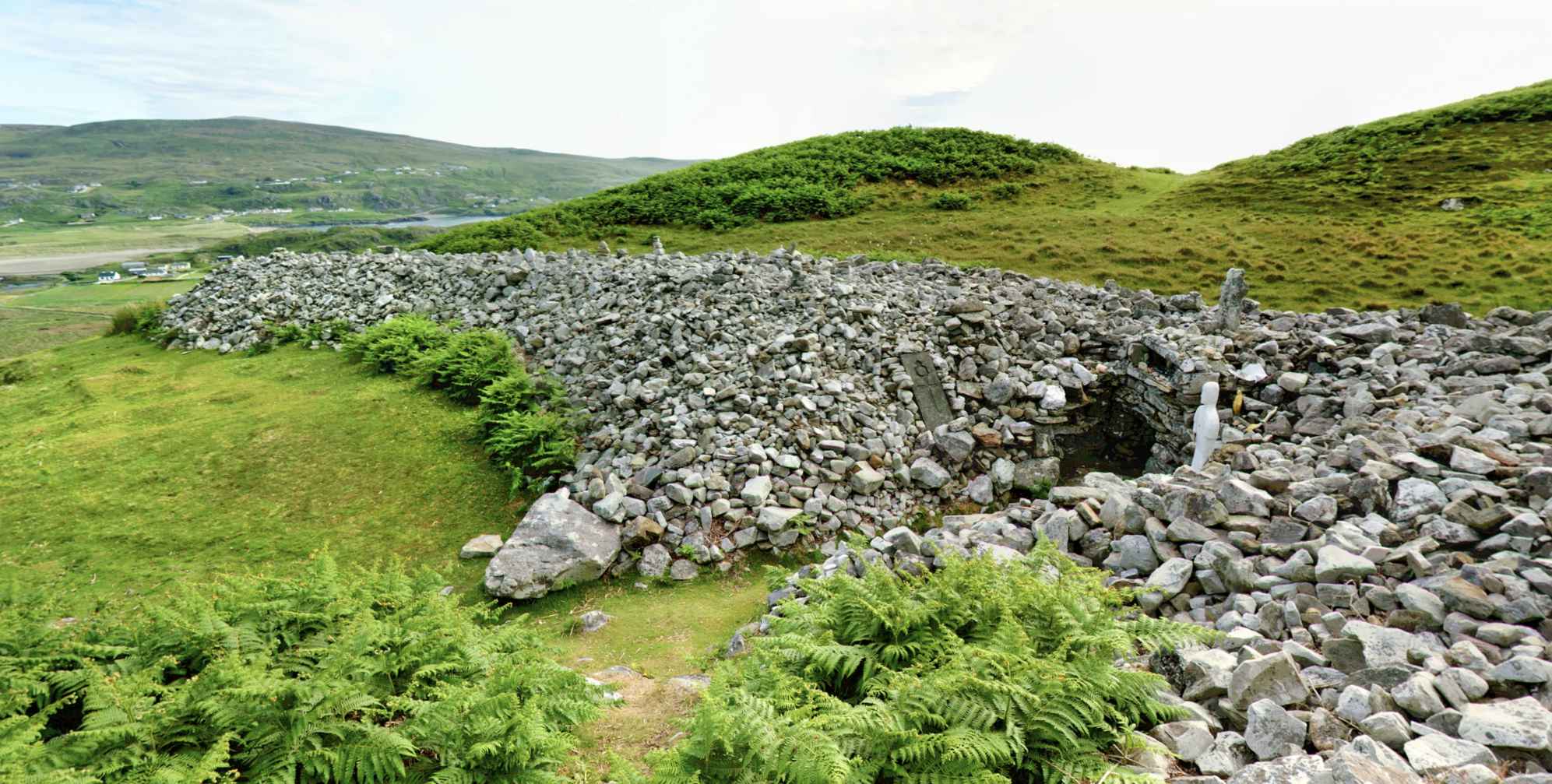
Turas Cholm Cille is one of Ireland’s best-known Christian rituals and predates the Christian era. According to prominent archaeologists, the standing stones are prechristian and were cross-inscribed in later centuries and assimilated into Christian religious practices.
| Location | Gleann Cholm Cille, Co Dhún na nGall |
|---|---|
| Categories | Social practices、rituals and festive events |
| Keywords | Religion, pilgrimage, festival |
| Contact organisation | Oideas Gael 074 9730248 oifig@oideasgael.ie |
Background information
Turas Cholm Cille is one of Ireland’s best-known Christian rituals and predates the Christian era. According to prominent archaeologists, the standing stones are prechristian and were cross-inscribed in later centuries and assimilated into Christian religious practices.
The Turas is usually walked barefoot, on June 9th and subsequent Sundays up to August 15th and takes around three hours. A particular set of prayers is recited at each slab, depending on whether the station is cross-inscribed or not. A number of the stations are especially central to the practice – such as Colmcille’s Well, placed in the centre of a large cairn of stones (several thousand stones that have been carried by pilgrims from the road for 150 metres up the side of the hill to the well.
The website www.voicesfromthedawn.com designed by Professor Howard Goldbaum and funded by numerous USA bursaries gives a spectacular 3D presentation of An Turas with local people offering their insights on the unique local tradition.
Tugtar deis do mhuintir an Ghleanna cursÃos ar chleachtas an Turais ó bhà siad óg.
Féach / Please view: http://www.voicesfromthedawn.com/glencolumcille/
Practice and practitioners
Naomh Colm Cille / Saint Columba (Irish: 'dove of the church’ was born on 7 December 521 and died 9 June 597). He was a prominent Irish abbot and missionary credited with spreading Christianity in what is today’s Scotland. He was of Donegal royalty and born in Gartan, north Donegal.
Gleann Cholm Cille (Glencolmcille) has strong historical associations with Colm Cille through folklore, placenames and particularly An Turas. Local people traditionalyl walked the Turas several times over the summer as it was regarded as being of equivalent indulgences as’ Loch Dearg’ (St Patrick’s Island Purgatory, 50 miles further south of the county.
The Turas survived long periods of non-practice by influences such as the penal laws and being banned by catholic priests who saw it as of pagan import.
The Turas is located in what is widely regarded as the remarkably scenic valley of Gleann Cholmcille. The stations or standing stones are located in highly visible locations are physically accessible. Local landowners and farmers make ready the access points to the station each year to allow locals and visitors to do the Turas.
Development, transmission and safeguarding
Oideas Gael has made determined efforts to ensure that the practices of An Turas and its rituals are passed from generation to generation. This generational Passover is often dependant of a few individuals and so-far has been successful. We are privileged to have one of the extra-valuable facsimiles of The Book of Kells in our institute and this attracts ongoing attention given that the Book of Kells’ is known as ‘ Leabhar Cholm Cille’.
The Folk Village exhibition shows the legacy of Fr McDyer who was regarded as a strong admirer of St Colm Cille and his story.
Oideas Gael (www.oideasgael.ie) is a Glencolmcille-based Irish language and Cultural organisation; it promotes An Turas by ensuring that maps are available; that the Turas stations are well marked and that An Turas is publicised and accessible to as many people as possible. ‘5,000 Years of Stone’ the Glencolmcille archaeology summer school, directed by Dr Brian Lacey, gives an annual focus to the heritage of St Colmcille.